


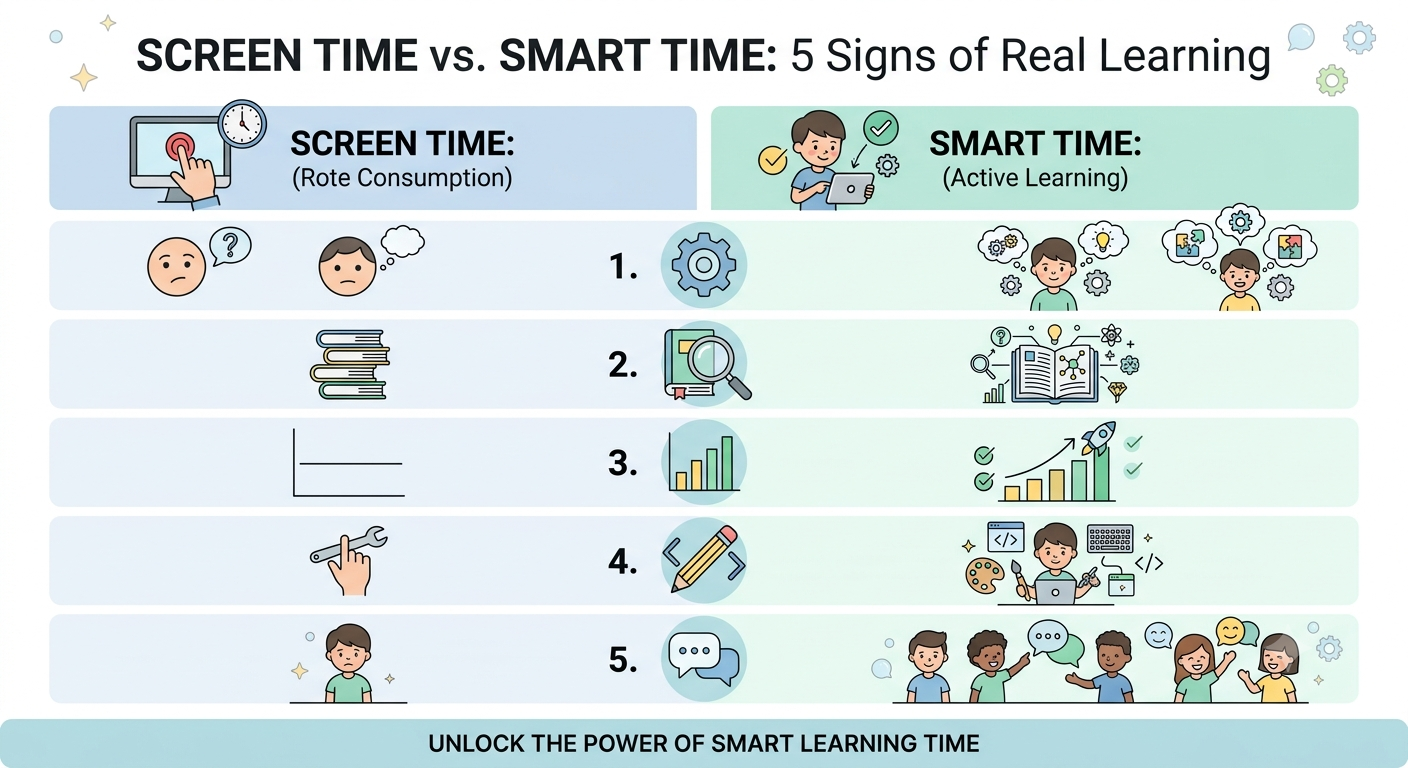
Screen time and smart time look the same on a report card, both count as hours on a device, but a child's brain treats them completely differently. Here are 5 signs that tell them apart.
Not more screen time." That is probably your first reaction when someone suggests online classes for your child.
In short: the real issue is not screens, it is passivity. A child watching a video for two hours and a child in a live, interactive class for 45 minutes are both technically on a screen, but their brains are doing completely different work. The fix is checking for interaction, not banning screens outright.
Show Image
TL;DR: Key Takeaways
- Doctors object to passive screen consumption, not screens themselves.
- A live class with real back and forth is not the same activity as watching a video.
- Good online learning has 5 checkable features, listed below.
- Personalised pacing is genuinely hard to get in a classroom of 30 plus kids.
- Boundaries still matter, even for high quality online learning.
Why Screens Get Blamed for the Wrong Problem
Doctors and child development experts generally do not object to screens themselves. What they object to is passive consumption, where a child sits back and watches rather than participates.
Two hours of cartoons and 45 minutes in a live interactive class both count as screen time on paper. In practice, they do almost nothing alike to a developing brain. One asks nothing of the child. The other asks them to speak, answer, and think on the spot.
What Does Good Online Learning Actually Look Like?
In a well run live class, your child is speaking, answering follow up questions, and getting real time feedback from an actual person. That is a fundamentally different kind of engagement than watching a video play out in front of them.
Here is what separates real interactive learning from screen filler:
- Instructor: a pre recorded video versus a real tutor who sees and hears your child
- Group size: a class of 40, muted, versus a small group or one on one setting
- Engagement: watching only versus questions, quizzes, and discussion
- Structure: a random assortment of videos versus a clear syllabus and structure
- Time boundary: unlimited access that blurs together versus a defined start and end time
If a program checks the second option on every point above, it functions closer to a tutor sitting across the table from your child than to a video platform. The medium is a screen. The experience is personal attention.
The Hidden Advantage: Personalisation
A good live online class can do something a crowded classroom often cannot: adapt to one specific child.
Say a child is confident speaking but weak on grammar. A live tutor can spend more time exactly there. Say a child grasps concepts fast but gets bored easily. The pace can shift to match. That kind of one to one calibration is hard to deliver in a classroom of 30 to 40 students.
"The medium is a screen. The experience is personal attention. That distinction is the entire argument."
How Do You Set Healthy Boundaries Around Online Classes?
Even a high quality program needs limits. Structure protects the benefit, it does not cancel it out.
- Fix the schedule. Keep classes tied to specific times, not "anytime" access.
- Sit in occasionally. Especially in the first few sessions, so you know what actually happens in there.
- Ask about content, not completion. "What did you do in class today" beats "did you finish it."
- Balance with offline time. Reading, play, and physical activity still matter, same as with any structured activity.
Frequently Asked Questions
Q: How much online class time is appropriate for a young child? Most child development guidance points to 30 to 60 minutes of focused, interactive instruction per session as reasonable for children aged 6 to 12, followed by a real break before any further screen use.
Q: Is a one on one online class better than a group class? It depends on the goal. One on one is stronger for targeted skill gaps, like grammar or pronunciation. Small group classes of 3 to 5 students still allow real interaction while adding peer learning.
Q: How can I tell if my child's online class is actually interactive, not just a video call? Sit in on one full session. If your child speaks, answers questions, and gets specific feedback more than a few times in 45 minutes, it is interactive. If they are mostly listening or muted, it is not.
Q: Does screen based learning affect a child's eyesight or attention span? Any screen use can cause eye strain, which is why session length and breaks matter. But attention span depends more on whether a child is actively engaged or just watching. An interactive class asks far more of a child's focus than a passive video does.
The Bottom Line
Used well, online learning does not compete with your child's development, it supports it. The real question in 2026 is not screen time versus no screen time. It is passive scrolling versus focused, one on one learning with a real person guiding the way.
At Addify Academy, every session is live and interactive. It is built around your child specifically, so the time they spend with us is time well spent, not just time online.
Want more on how screen quality affects developing brains? The American Academy of Pediatrics has published clear guidance on media use for young children.
Does your child's current online class pass the 5 point checklist above? Tell us where it falls short, we read every comment.