


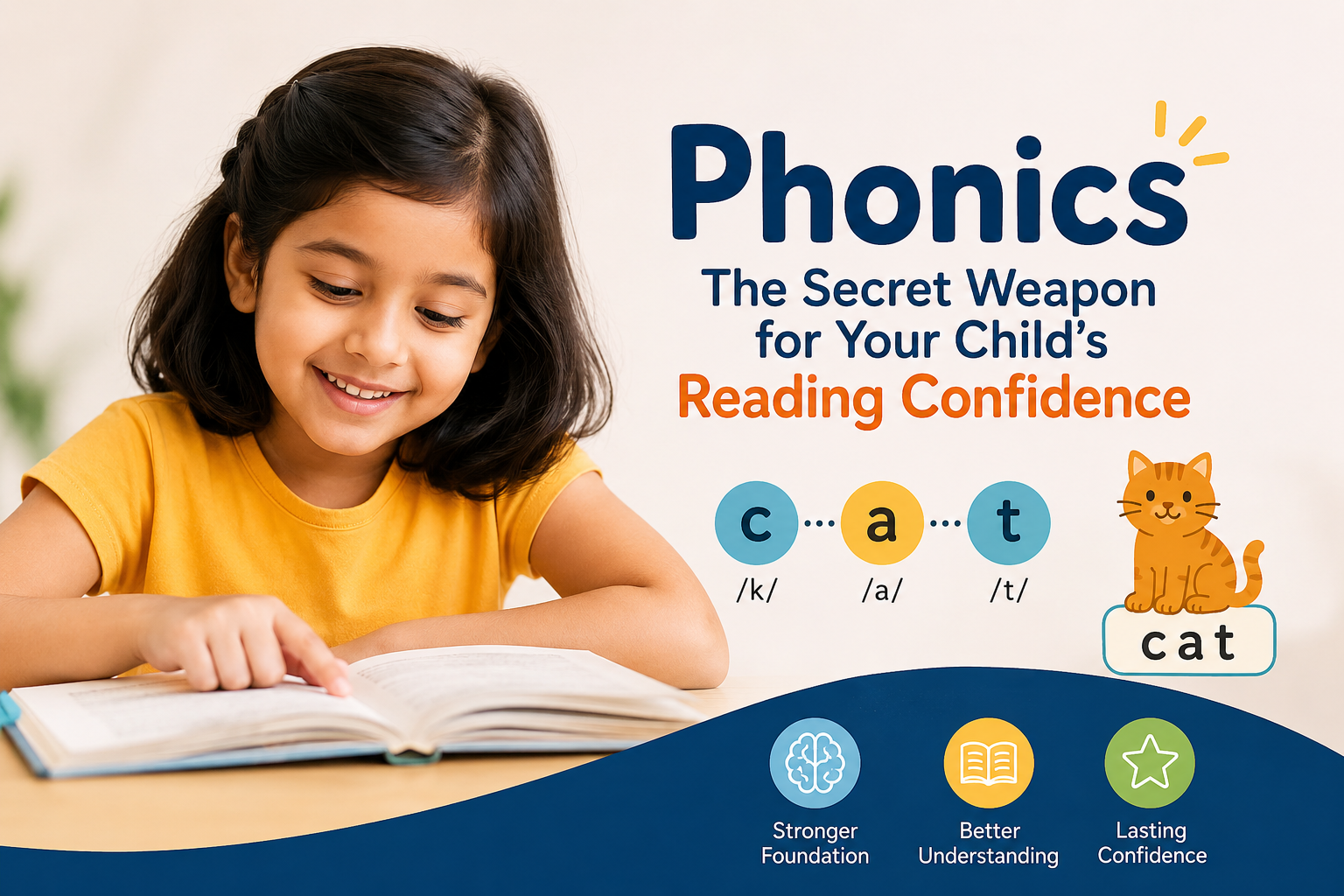
7 Phonics Secrets That Build Confident Child Readers
Your child can sing the alphabet song perfectly. Then they hit a real book and freeze on the word "cat." Sound familiar?
Quick answer: Phonics teaches children to connect letters to the sounds they make, so they can sound out new words instead of guessing. Kids who learn phonics properly read faster, understand more, and enjoy books instead of dreading them. Most reading struggles between ages 4 and 10 trace back to this one missing skill.
TL;DR: Key Takeaways
- Phonics means matching letters to sounds, then blending those sounds into words
- Most Indian schools still teach "look and say," where kids memorise whole words by shape
- That method breaks down the moment a child meets an unfamiliar word
- Reading fluency built between ages 4 and 10 predicts stronger performance in every other subject later
- A structured, sound first phonics program closes reading gaps faster than trial and error at home
What Is Phonics, Really?
Phonics is the relationship between written letters and spoken sounds. A child who knows phonics does not memorise "cat" as a shape on a page. They break it into three sounds, c, a, t, and blend those sounds together to read the word.
This sounds small. It is not. It is the difference between a child who can read any word they have never seen before, and a child who can only read words they have already memorised.
Why "Look and Say" Falls Apart
Most Indian classrooms lean on the "look and say" method. Children learn to recognise whole words by sight, the same way you recognise a friend's face. This works fine for a small, familiar set of words.
The problem shows up the moment a child meets something new. A child taught to memorise shapes has no system for decoding an unfamiliar word. They either guess from the picture next to it, skip it, or freeze. A child taught phonics has a tool that works on any word, familiar or not.
According to the National Reading Panel's landmark report to the US Congress, systematic phonics instruction significantly improves reading, spelling, and comprehension outcomes compared to approaches that skip phonics, particularly for children in kindergarten through sixth grade (National Institute of Child Health and Human Development, 2000).
Is Your Child Missing This Foundation? (Signs to Watch For)
Here is a quick checklist. If two or more apply, phonics is likely the gap.
Sign
What it looks like
- Word freezing
- Reads familiar words fine, stalls on new or longer ones
- Picture guessing
- Guesses a word from the illustration instead of sounding it out
- Word skipping
- Skips unfamiliar words entirely rather than attempting them
- Slow, joyless reading
- Reading feels effortful and mechanical, not natural
- No blending
- Can name letters but cannot combine their sounds into a word
None of this means a child is behind in a deeper sense. It almost always means the letter to sound connection was never built properly, and it is fixable at any age.
Why Fixing This Early Changes Everything Later
Reading is the base layer under every other subject. A fluent reader in Class 3 grasps a science paragraph faster, solves a word problem in math with less friction, and writes a more organised essay.
A child still decoding word by word spends all their mental energy on the mechanics of reading. There is nothing left over for comprehension, vocabulary, or actually enjoying the story.
"A child who reads fluently isn't just reading faster. They're thinking faster, because their brain isn't stuck decoding, it's free to understand."
Research consistently shows that children who read fluently by age 8 or 9 are far more likely to be proficient readers throughout their schooling, while children who fall behind at that stage rarely catch up without targeted intervention (Annie E. Casey Foundation, Double Jeopardy report).
5 Simple Phonics Games You Can Try at Home Today
- Sound hunts in the car: "I'm thinking of an animal that starts with the sound mmm."
- Beginning and ending sounds: Point them out in everyday words, not just during homework.
- Repeated reading: Read the same short book together more than once, letting your child take over more of it each time.
- Delayed correction: Let your child attempt to sound out a word before you jump in to help.
- Blending practice: Say a word slowly in separate sounds and ask your child to guess it, then swap roles.
Frequently Asked Questions
What age should a child start learning phonics? Most children are ready to start around age 4, once they can recognise individual letters. Structured phonics instruction typically runs from age 4 through age 8 or 9, though it is never too late to build the skill.
How long does it take to see results from phonics instruction? With consistent, structured practice, most children show noticeable improvement in decoding and reading confidence within 8 to 12 weeks.
Can phonics help a child who is already reading but reading slowly? Yes. Slow, effortful reading is often a sign of weak phonics fundamentals, even in children who technically know how to read. Strengthening the letter to sound connection usually increases both speed and comprehension.
Is phonics only useful in English, or does it apply to other languages too? Phonics as a concept, connecting sounds to written symbols, applies across alphabetic languages. The specific method used at Addify Academy is built for English reading fluency.
The Bottom Line
A confident reader today becomes a confident student tomorrow, and it starts with something as small as getting comfortable with the sound of a single letter.
If your child is between 4 and 10 and reading still feels like a struggle rather than a skill they enjoy in 2026, a structured phonics program with a trained tutor closes that gap far faster than trial and error at home. Addify Academy's young learners phonics program is built around exactly this kind of one on one, sound first approach, so children build reading confidence instead of reading anxiety.
Has your child hit the "freeze on new words" stage? Tell us in the comments, we read every one and often reply with a specific tip for your child's age.