


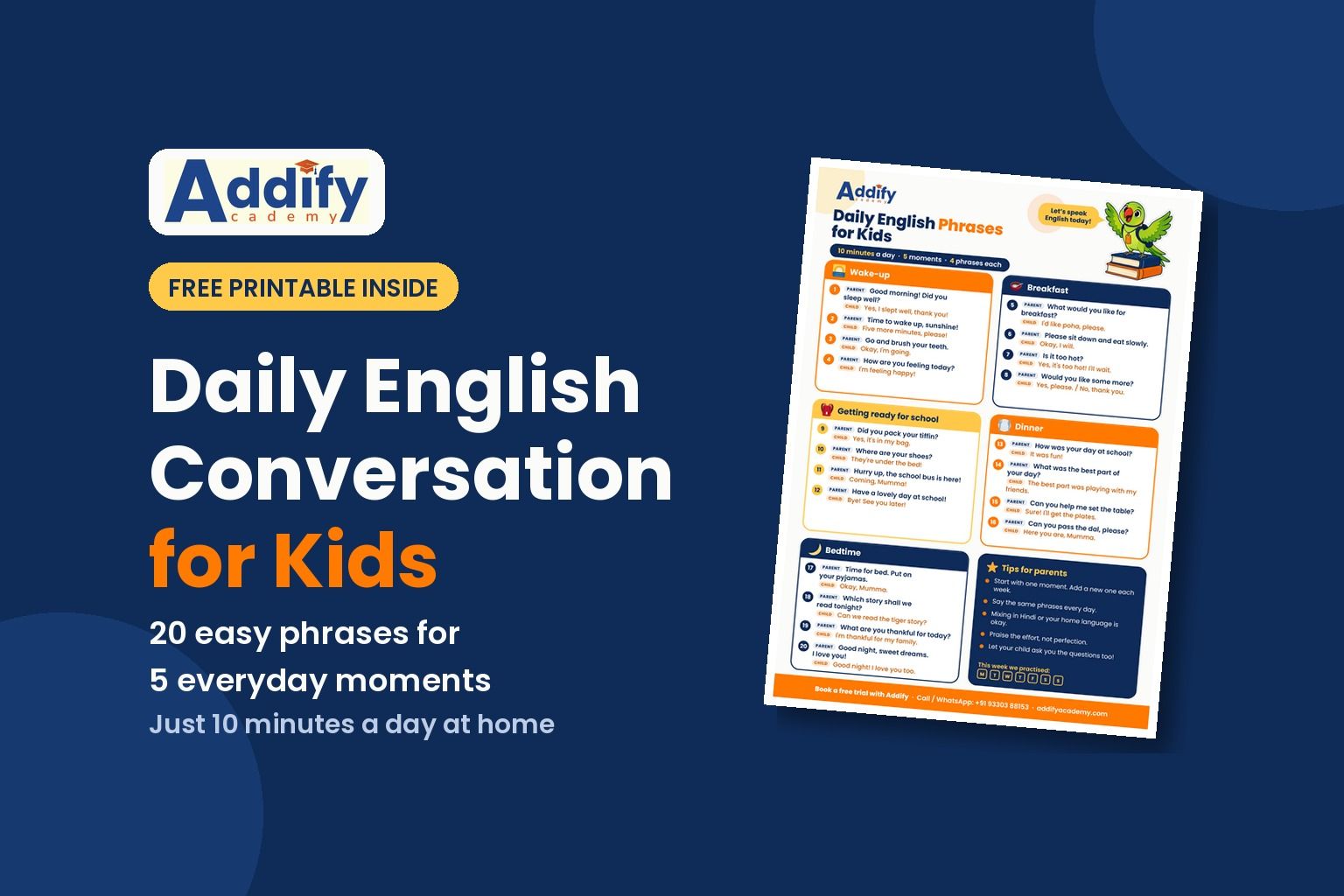
Want your child to speak English at home? Use 20 easy phrases at 5 daily moments, just 10 minutes a day. Free printable fridge sheet included!
Want to know how to make your child speak English at home, without it feeling like homework? Here is the simple answer: use English for just 10 minutes a day, at 5 everyday moments (wake-up, breakfast, getting ready for school, dinner and bedtime), with 4 easy phrases for each moment. That's 20 phrases in total, and you already have every one of these moments in your day.
Below you'll find all 20 phrases, with a parent line and a child reply, plus a free printable fridge sheet so the whole family can practise together.
Why everyday moments work better than "English time"
Many parents try to set aside a special "English hour", and it rarely lasts. School, homework, tuition and family life get in the way.
Everyday moments are different. You wake your child up every morning. You eat dinner together every evening. When English is attached to things you already do, it happens naturally, without extra time or effort.
Children also learn to speak by hearing the same words again and again in real situations. When "Did you pack your tiffin?" is asked every morning, your child soon answers without thinking. That is the confidence we want.
A few simple rules before you start:
- Pick one moment to start with. Add a new one each week.
- Say the same phrases every day. Repetition is your best friend.
- It's okay to mix in Hindi or your home language. English can sit alongside it.
- Praise the effort, not perfection. Gently repeat the right sentence instead of saying "wrong".
1. Wake-up time: 4 morning phrases
The first words of the day set the mood. Keep them short, cheerful and the same every morning.
- Parent: "Good morning! Did you sleep well?" Child: "Yes, I slept well, thank you!"
- Parent: "Time to wake up, sunshine!" Child: "Five more minutes, please!"
- Parent: "Go and brush your teeth." Child: "Okay, I'm going."
- Parent: "How are you feeling today?" Child: "I'm feeling happy!"
Parent tip: Say it with a smile and a hug. A warm first sentence makes English feel like part of the family, not a lesson.
2. Breakfast: 4 phrases at the table
Breakfast is a sit-down moment, which makes it perfect for simple questions and polite words.
- Parent: "What would you like for breakfast?" Child: "I'd like poha, please."
- Parent: "Please sit down and eat slowly." Child: "Okay, I will."
- Parent: "Is it too hot?" Child: "Yes, it's too hot! I'll wait."
- Parent: "Would you like some more?" Child: "Yes, please. / No, thank you."
Parent tip: Let your child answer in a full sentence, then simply repeat it back happily. No need to correct every word.
3. Getting ready for school: 4 school-bag phrases
Yes, mornings are chaotic. That is exactly why these phrases work: you say them every single day anyway.
- Parent: "Did you pack your tiffin?" Child: "Yes, it's in my bag."
- Parent: "Where are your shoes?" Child: "They're under the bed!"
- Parent: "Hurry up, the school bus is here!" Child: "Coming, Mumma!"
- Parent: "Have a lovely day at school!" Child: "Bye! See you later!"
Parent tip: Mornings are rushed, so pick just one phrase you say every single day. Repetition does the teaching for you.
4. Dinner: 4 phrases to talk about the day
This is the moment for real conversation. Your child has a whole day of stories, so give them the chance to tell one.
- Parent: "How was your day at school?" Child: "It was fun!"
- Parent: "What was the best part of your day?" Child: "The best part was playing with my friends."
- Parent: "Can you help me set the table?" Child: "Sure! I'll get the plates."
- Parent: "Can you pass the dal, please?" Child: "Here you are, Mumma."
Parent tip: Ask open questions and really listen. Dinner is the best time for your child to speak more than one line.
5. Bedtime: 4 calm good-night phrases
Calm, cosy and slow. Bedtime is when children are most relaxed, and most likely to try new words.
- Parent: "Time for bed. Put on your pyjamas." Child: "Okay, Mumma."
- Parent: "Which story shall we read tonight?" Child: "Can we read the tiger story?"
- Parent: "What are you thankful for today?" Child: "I'm thankful for my family."
- Parent: "Good night, sweet dreams. I love you!" Child: "Good night! I love you too."
Parent tip: Keep bedtime English calm and slow. A short story and a 'thank you' sentence end the day on a happy note.
Get the free printable fridge sheet
To make this easy, we've put all 20 phrases on one colourful page, grouped by the 5 moments. Print it, stick it on your fridge, and glance at it while you make breakfast or pack the tiffin. Your child can follow along too, and many children love "reading" their own lines.
Get it free on WhatsApp: message us "FRIDGE SHEET" on +91 93303 88153 and we'll send it to you.
How to keep it going (without stress)
- Week 1: Wake-up and bedtime only. These are the calmest moments.
- Week 2: Add breakfast and dinner.
- Week 3: Add the school-bag phrases.
- Then: Let your child ask you the questions. Children love being the "parent" for a minute.
If your child goes quiet or replies in Hindi, that's completely normal. Keep using the phrases warmly, and the replies will come with time.
Want your child to speak English with confidence?
These phrases are a wonderful start at home. If you'd like a teacher to build your child's spoken English step by step, Addify offers Live 1-to-1 lessons online for children aged 4 to 12, whether you're in India, the UAE, the UK or the US.
👉 Book a free trial with Addify at addifyacademy.com 📞 Call / WhatsApp: +91 93303 88153
Frequently asked questions
- At what age should I start speaking English with my child at home?
- You can start at any age. These phrases suit children from about 4 to 12. Younger children can simply listen and repeat one word, and older children can answer in full sentences.
- I'm not confident in my own English. Can I still do this?
- Yes. These 20 phrases are short and simple, and you can learn them alongside your child. What matters most is that you use them warmly and every day, not that your English is perfect.
- What if my child answers in Hindi or doesn't reply at all?
- That's very common, so don't worry. Smile, say the English reply yourself ("Oh, you mean: Yes, I slept well!"), and keep going. Never force it. Children start replying once the phrases feel familiar.